


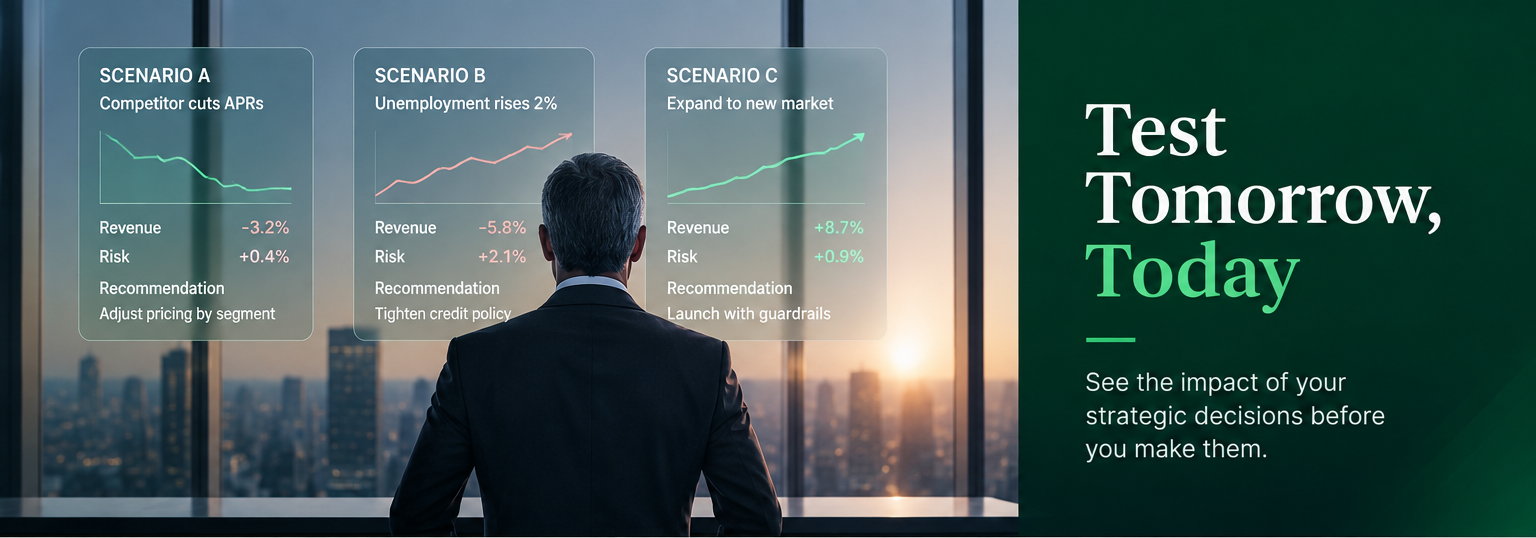
Interrogate your own evidence.
Discovery Agents are the fastest thing AI can do for a lending portfolio, and they run before a single scenario is simulated. You’re sitting on an information gold mine.
Ask a Chief Risk Officer which levers actually move their book, and by how much, and you will usually get a project rather than an answer. A team gets pulled. An analyst reconstructs three years of test history from shared drives and old decks. The answer arrives a quarter later, partial, and by then two of the policies it describes have already changed.
The evidence exists. It sits in champion/challenger write-ups, credit policy documents, treatment strategies, scorecard memos, and quarterly reviews, accumulated across teams and across years. Traditional analytics report what happened in the portfolio, and they report it well. What no lender has on hand is a reading of what all of that accumulated evidence adds up to, and where it contradicts itself.
That is what a Discovery Agent produces.
What a Discovery Agent Actually Does
Think of it as a new chief of staff who spends their first months reading every test write-up, policy document, and treatment strategy in the building, then tells you what they add up to. This one reads all of it, finishes in weeks, and cites the source behind every claim it makes.
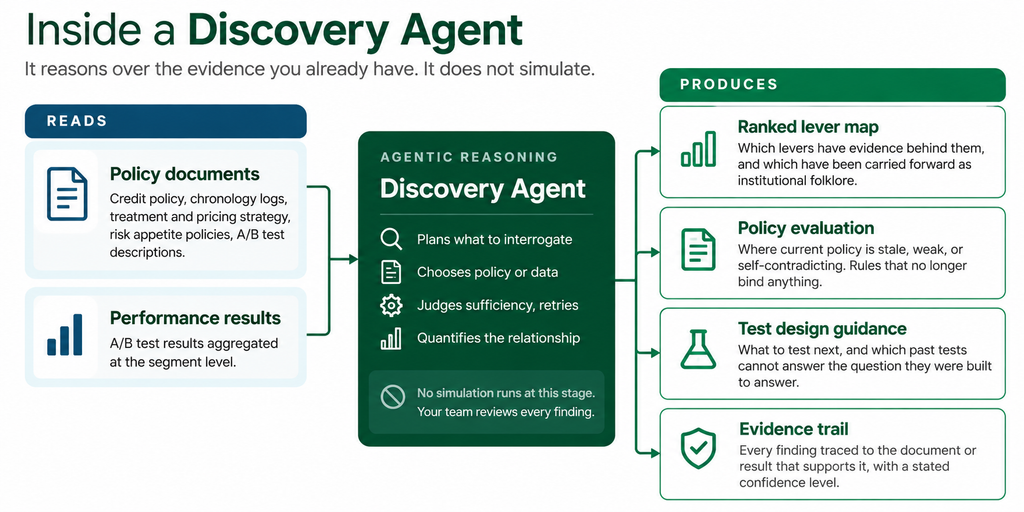
The mechanics are simpler than the category suggests. A Discovery Agent reads two kinds of material: the policy documents that describe what your lender intends to do, and the performance and test results that record what actually happened. It reasons across both, quantifies the relationships the evidence can support, and says plainly where the evidence runs out. A Discovery Agent does not run your portfolio. It does not simulate and it takes no action on a single account.
This is the role of the Discovery Agent in BankersLab Command Center, an AI decisioning solution that uses agentic reasoning, not autonomous agents.
What You Get Before Anything Is Simulated
A strategic Discovery Agent does more than find information. It turns the evidence into four distinct outputs, each useful on its own and stronger when considered together.
A ranked lever map. Which levers have evidence behind them, and which have been carried forward as institutional folklore because the person who questioned them left in 2022.
A policy evaluation. Where current policy is stale, weak, or self-contradicting. Rules that no longer bind anything. Two documents that assign the same segment to different treatment.
Test design guidance. What to test next, and, more usefully, which past tests were designed in a way that means they cannot answer the question they were built to answer.
An evidence trail. Every finding traced back to the document or the result that supports it, with a stated confidence level.
Everything the Discovery Agent produces arrives with its provenance attached. That is what makes the output defensible in a model risk review rather than merely interesting in a management meeting.
BankersLab Command Center turns discovery into governed decision support. Your team can see where an insight came from, challenge the reasoning, and decide what to do with it.
The Data Request Is Low-Friction, and It Contains No Personal Information
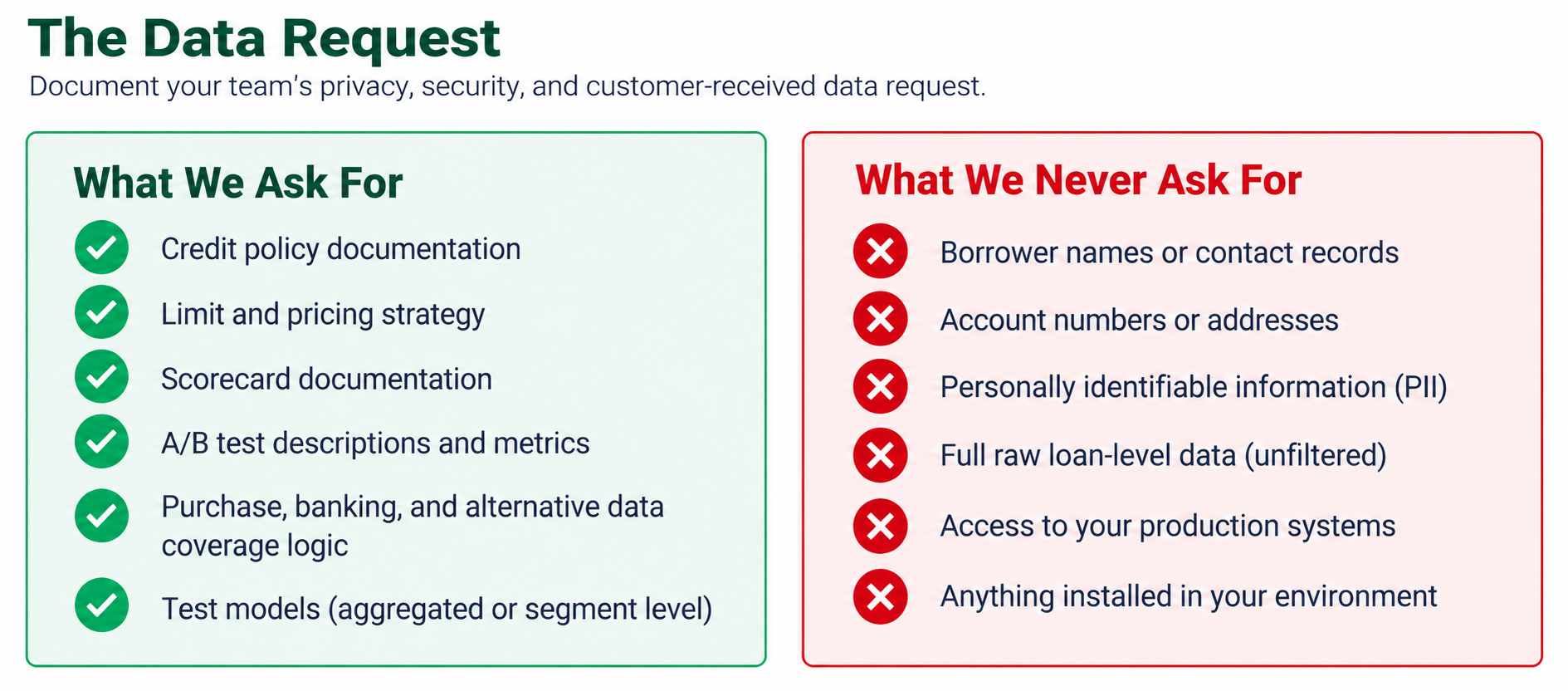
AI initiatives rarely stall on the tech. They stall on data access. Six months disappear before anyone builds anything.
Discovery has a different starting position, because of what it does not need.
With BankersLab Command Center, we ask for material your teams already maintain: credit policy documentation, treatment and pricing strategy, scorecard documentation, A/B test descriptions and write-ups, collections wiki exports. Alongside that, aggregated test results at the segment level.
What we do not ask for is any personally identifiable information. No names, account numbers, addresses, and no contact records. No customer-level data of any kind and no access to your production systems.
Nothing to Install
BankersLab hosts Discovery in a private cloud instance dedicated to your institution. Your material stays in that instance.
There is no installation inside your environment, no integration work, and no new production system for your technology team to onboard. Your team reaches it through a browser.
There is a Human-in-the-loop throughout our platform: your team reviews and approves every recommendation. Full audit trails and lineage on every finding. Your risk guardrails and credit policy are configured into the knowledge base from day one.
Why This Is the On-Ramp to Simulation and Digital Twins
In Command Center, this Discovery work is your onramp to full portfolio simulation. The quantified cause-and-effect parameters that Discovery produces are precisely the inputs the simulation consumes. Discovery is stage one of the same programme, and it is the stage that pays back first.
Discovery reasons over the evidence you already have.
Simulation tells you what happens next.
Where to Start
Pick one decision area. Send us the policy documents and test results you already hold for it. We run a scoped Discovery engagement against that corpus and come back with the lever map, the policy findings, the evidence trail, and a recommendation for what to test next.
BankersLab Command Center turns that decision area into a permanent source of decision intelligence. It connects policy, performance, tests, and external signals to show what the evidence says, what matters, and what to explore next.
Then your team can ask questions of the future portfolio, test scenarios, and review explainable recommendations with the evidence attached. No personal data. Nothing to install. One decision area, read properly, for the first time.