

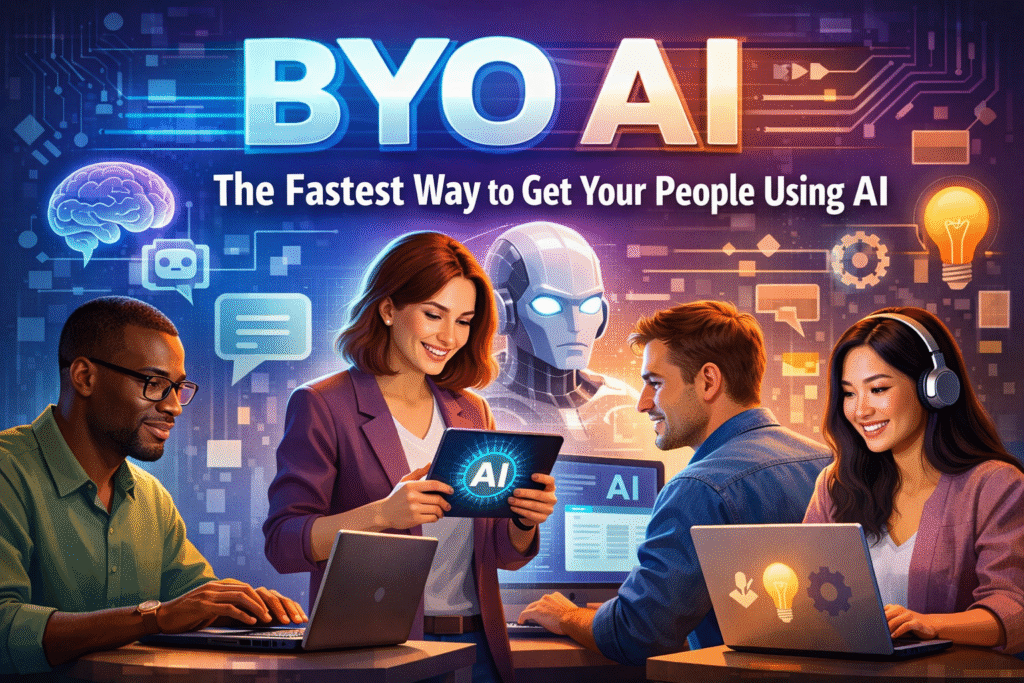
Your teams now have corporate access to Co‑Pilot, Gemini, and internal LLMs. So why aren’t they using them yet?
Most banks and fintechs have rolled out AI tools to thousands of staff… and discovered that access does not equal adoption. People are busy. They’re nervous about “breaking something.” And nobody wants to experiment on live customers.
That’s exactly the gap BankersLab’s simulation competitions are built to close—with a new twist: BYO AI. Bring your own AI.
The problem: AI tools, but no muscle memory
From credit officers to product managers, your people keep hearing “use AI more.”
What they actually feel is:
· “I don’t have time to figure this out.”
· “Since I’m not a data scientist—what if I misinterpret the output?”
· “How does this help with my real portfolio and P&L?”
Traditional training—slides and demos—doesn’t fix that. People learn lending by doing: designing strategies, seeing the numbers move, and debating the trade‑offs. They need the same, but with AI in the loop.
The BankersLab on‑ramp: simulation competitions
BankersLab’s gamified workshops already put lending teams into a realistic, high‑pressure environment where every decision hits a simulated P&L. Think “flight simulator for lenders”: you tweak pricing, credit policy, and collections tactics; the simulation shows how your book performs over time—without risking a single real customer.
In our new format, we add one simple rule:
Teams must BYO AI.
Every team comes into the competition using the AI tools their bank or fintech already rolled out—Co‑Pilot, Gemini, internal LLMs, or other approved copilots. No new software to buy, no extra approvals. Just bring what you already have.
How BYO AI works in the competition
1 Run the Simulation
- Teams make lending decisions: approve/decline rules, line management, pricing, collections strategies
- The simulation provides the results: volumes, losses, ROA, customer outcomes
The result is a fast‑paced, competitive environment where teams build real‑world AI skills against realistic lending scenarios, safely.
2 Bring in Your Own AI: After each round, teams must use their internal AI tools to:
- Analyze the data – Ask the AI to explore trends:
- “Which segments drove the spike in losses?”
- “What changed in roll rates after we tightened policy on near‑prime?”
- Create actionable insights – Turn analysis into decisions:
- “Given this pattern, what are three options to improve ROA without breaching risk appetite?”
- “If we adjust pricing for this segment, what second‑order effects should we watch?”
- Clearly document their investigation – Use the AI to help structure reasoning:
- Assumptions, alternatives considered, and why they chose a particular strategy.
- Risks, monitoring metrics, and “what we’ll do next if this doesn’t work.
- Summarize and present findings visually – Ask the AI to draft slides, charts, or narrative summaries that the team can refine and present.
- The core rule: the AI does the heavy lifting, but humans stay in charge of judgement.
3 Present, debate, repeat
- Teams present to a mock “credit committee” of peers and facilitators.
- They defend not only their strategy, but how they used AI to get there.
- The next round starts with improved strategies—and smarter AI prompts.
The result is a fast‑paced, competitive environment where teams build real‑world AI skills against realistic lending scenarios, safely.
Why this works
This format hits several pain points for banks and fintechs in Asia Pacific and beyond:
- Immediate relevance
The scenarios speak the language of your portfolios: personal loans, cards, BNPL, micro‑SME, local regulation, and regional market shocks. Participants see exactly how AI can help with the decisions they make every day.
- Hands‑on, not hypothetical
People use AI against real numbers, trade‑offs, and customer outcomes inside the simulation—not toy examples. That builds confidence quickly.
- Safe space to try, fail, and learn
Mistakes are cheap in simulation. Teams can ask “dumb questions” of their AI, push its limits, and see where it helps and where it falls short—without compliance breathing down their necks.·
- Drives adoption of tools you already paid for
You’ve invested in licenses and internal LLMs. BYO AI competitions turn that spend into visible behavior change and usage, without new tools or long projects.
What your teams walk away with
After a BYO AI simulation competition, lending teams typically:
- Have 10–20 concrete examples of “this is how I’ll use AI on Monday” in their own job.
- Know how to prompt AI to analyze portfolio data, not just write emails.
- Understand that AI is a decision support partner—not a black‑box oracle.
- Feel energized, not threatened, by AI’s role in lending.And you, as a leader, get something even more valuable: a visible, practical story to tell your board and regulators about how you are upskilling staff and governing AI use in real decisions, not just experimenting.
Ready to let your teams BYO AI?
If your organization has rolled out AI tools but usage is stuck at “early curiosity,” a BYO AI simulation competition is the easiest, most enjoyable on‑ramp you can give your people.
They will:
- Compete.
- Learn.
- Make smarter, faster lending decisions.
- And finally, put your AI tools to work—where it matters most: your portfolio.